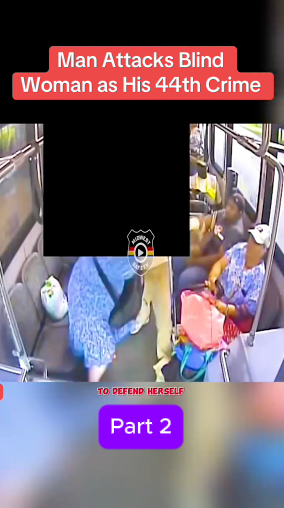
👇 SCROLL DOWN TO WATCH THE VIDEO! 🎥🚨
Police Arrest Repeat Offender After Brutal Attack on Blind Woman — 44th Crime Sparks Outrage and Legal Questions
SAVANNAH, GEORGIA — A violent attack aboard a public transit bus left a blind woman and a bus driver injured, triggered a police investigation, and renewed questions about repeat offenders, victim protection, and accountability within the criminal justice system.
The suspect, Brandon Collier, had an extensive history of arrests in Chatham County, according to local news reports. The June 2025 incident in Savannah drew additional attention because the victims included a woman with a visual disability who was riding a Chatham Area Transit bus.
The case also raised questions about criminal defense attorneys, victims’ rights, civil lawsuits, and the responsibility of public agencies to protect passengers and employees.
Although online headlines described the incident as Collier’s “44th crime,” arrest records and local reporting require a distinction: WTOC reported that the June incident was his 43rd arrest in Chatham County. An arrest is not the same as a conviction, and the number of arrests should not be treated as proof that every alleged offense was committed.
A Routine Bus Ride Turns Violent
On June 16, 2025, Savannah police responded to an incident involving a passenger and a driver aboard a Chatham Area Transit bus near Waters Avenue and Lexington Avenue.
According to police information reported by WTOC, the man had been acting disorderly. A female passenger reportedly attempted to intervene or tell him to stop, after which he allegedly attacked her. The bus driver then attempted to intervene and was also assaulted.
The police report described serious injuries to both victims. The woman was blind and reportedly suffered multiple injuries to her face, neck, and forehead. Officers also documented significant damage to the protective barrier separating the driver from passengers.
Both victims were taken for medical treatment. The suspect allegedly left the bus and fled before police identified him using security footage. Officers arrested 40-year-old Brandon Collier later that day. <Cite refs={[“turn251372search0″,”turn251372search6”]}/>
The reported attack quickly became a public safety concern. Passengers rely on public transportation to reach work, medical appointments, school, and essential services. A violent incident inside a bus can therefore affect not only the immediate victims but also other riders and transit employees.
How Police Identified and Arrested the Suspect
Investigators used security video to help identify Collier, according to local reporting. Surveillance footage can be important in a public assault investigation because it may show the sequence of events, the actions of people involved, and the suspect’s movements before or after the incident.
However, video evidence must be assessed carefully. A recording may not capture every angle or everything that happened before a confrontation began. Investigators may need to compare the footage with witness statements, police reports, medical records, and other evidence.
After the arrest, Collier faced criminal allegations arising from the incident. An indictment reported by WTOC in July 2025 included charges involving aggravated assault, aggravated battery, exploitation and intimidation of a disabled adult or elderly person, criminal damage to property, and obstruction of an officer. The precise legal significance of each count depends on Georgia law and the evidence presented. <Cite refs={[“turn251372search2″,”turn251372search7”]}/>
Why the Victim’s Disability Matters Legally
The alleged attack raised particular concern because one victim was blind.
Disability-related protections may be relevant when prosecutors determine which charges are supported by the evidence. Georgia law includes provisions addressing certain offenses against disabled adults and elderly people. Whether a particular charge applies depends on the statutory elements and the facts established by investigators.
The victim’s disability does not, by itself, prove every element of a crime. Prosecutors must establish the required facts through admissible evidence.
At the same time, a victim’s disability may create practical barriers when seeking help, communicating with investigators, or navigating court proceedings. Police departments and victim support services should make reasonable efforts to ensure that victims can participate meaningfully in the process.
What Criminal Charges Could Mean for the Defendant
Aggravated assault and aggravated battery are serious offenses under Georgia law. The penalties depend on the specific charge, the circumstances, applicable sentencing provisions, and the defendant’s criminal history.
A criminal defense lawyer represents the accused and examines whether the prosecution can prove each required element beyond a reasonable doubt.
In a case involving a public transit assault, defense counsel may review surveillance footage, witness accounts, police procedures, medical evidence, and the circumstances of the arrest. The attorney may also assess whether statements were obtained lawfully and whether the evidence supports each charge.
Providing a defense does not mean endorsing the alleged conduct. It is part of the justice system’s requirement that criminal responsibility be established through a fair legal process.
Likewise, an arrest record should not be confused with a series of convictions. Previous cases may have ended in different ways, and the legal significance of each one must be established through reliable records.
The Controversy Surrounding Repeat Offenders
Collier’s criminal history became a major part of public discussion after the bus incident. WTOC reported that he had been arrested 43 times in Chatham County before the incident became the subject of its June 2025 coverage. The station later reported that Collier had been involved in separate cases involving other alleged assaults. <Cite refs={[“turn251372search4″,”turn251372search6”]}/>
The history prompted questions about how courts make decisions concerning release, supervision, and public safety.
Those decisions involve several considerations, including the charges in the current case, a defendant’s documented record, the risk of failing to appear in court, and any legally relevant safety concerns. The rules differ depending on the proceeding and applicable law.
Prior arrests alone do not establish guilt or automatically require detention. Courts must apply the relevant legal standards, while prosecutors and defense attorneys may present information that is legally admissible and relevant to the decision.
The broader policy question remains difficult: how can the justice system protect the public while respecting due process and avoiding decisions based solely on unproven allegations?
Can the Victims File a Civil Lawsuit?
Criminal prosecution and civil litigation serve different purposes.
A criminal case determines whether the defendant committed an offense and what criminal consequences should follow. A civil lawsuit may allow an injured person to seek compensation for legally recognized losses.
A personal injury attorney could help an injured victim assess whether a civil claim is available against the person alleged to have caused the harm.
Potential damages in a successful claim may include qualifying medical expenses, rehabilitation costs, lost income, and compensation for pain and suffering where permitted by law. The amount, if any, depends on the evidence, the severity of the injuries, applicable law, and the defendant’s ability to pay.
A civil recovery is not guaranteed simply because a criminal arrest occurred. A lawyer must evaluate liability, causation, available evidence, insurance coverage, and filing deadlines.
Could the Transit Agency Face Legal Liability?
An incident aboard public transportation may also lead to questions about the safety measures used by the transit agency.
After the June attacks, Chatham Area Transit discussed steps to improve safety, including ordering new protective shields for buses and reviewing driver training, according to WTOC reporting. The agency also highlighted its existing camera systems. <Cite refs={[“turn251372search5”]}/>
Whether a transit agency could be held liable for an assault is a separate legal question. The fact that a crime occurred on a bus does not automatically establish that the agency was negligent.
A civil attorney would need to examine the relevant duties, what the agency knew or reasonably should have known, the precautions in place, and whether any alleged failure legally caused the victim’s injuries. Claims involving public agencies may also be subject to special notice requirements, deadlines, and legal defenses.
A civil litigation lawyer familiar with government liability can explain whether the facts support a claim and what procedural rules apply.
Victims’ Rights and the Importance of Communication
The case also drew attention to the way crime victims are informed about developments in criminal proceedings.
WTOC reported in July 2025 that a victim advocate in the Chatham County District Attorney’s Office was fired after an internal review found failures in communication with crime victims, including a failure to notify one victim that Collier had been released on bond in a separate case. The office said it was contacting other affected victims. <Cite refs={[“turn251372search4”]}/>
This issue highlights the importance of victim notification systems.
Victims may need to know about court hearings, release conditions, plea agreements, and sentencing. The specific rights and procedures depend on state law and the circumstances of the case.
A victim advocate can help explain the court process and connect victims with support services. A victims’ rights attorney may provide legal advice about protections, notifications, restitution, and other available remedies.
The prosecution remains responsible for pursuing the criminal case; a victim’s attorney does not replace the prosecutor.
The Case’s Outcome: A Plea Agreement and a 20-Year Sentence
In October 2025, WTOC reported that Collier entered a plea agreement in two cases, including the transit-bus attack and a separate case involving an earlier confrontation. The station reported a total sentence of 20 years, consisting of 10 years in prison and 10 years on probation. The report also stated that, because he was sentenced as a repeat offender, he would not be eligible for parole, and that the judge required a substance-abuse evaluation and treatment. <Cite refs={[“turn251372search1″,”turn251372search3”]}/>
The sentence represented a significant development for the victims and the community. It also demonstrated why accurate reporting must distinguish the initial allegations, the charges filed, and the eventual court outcome.
A plea agreement resolves a criminal case under agreed terms, subject to the applicable legal process. It does not automatically resolve every possible civil claim or determine all questions about public agency responsibility.
What Legal Services May Be Relevant After an Assault?
Victims of serious violence may need help with several different issues.
A personal injury lawyer can assess potential compensation claims. A victims’ rights attorney can explain rights and procedures within the criminal justice system. A civil litigation lawyer can review whether a claim against another responsible party is legally supportable.
The defendant, meanwhile, may require criminal defense representation to address the charges and sentencing issues.
These services are not interchangeable. People should seek an attorney whose experience matches their particular legal needs and who is licensed in the relevant jurisdiction.
Final Thoughts: Accountability Requires Evidence and Fair Procedures
The attack aboard a Savannah transit bus was a serious incident involving an alleged assault on a blind passenger and a bus driver who intervened. The case also raised wider concerns about public transportation safety, repeat-offender policies, and how victims are supported during criminal proceedings.
Police used security footage to identify the suspect, prosecutors pursued criminal charges, and the case ultimately resulted in a plea agreement and a substantial prison sentence, according to local reporting.
The lesson is not that every arrest proves guilt or that a lengthy arrest history alone determines a person’s legal responsibility. It is that public safety depends on thorough investigations, lawful procedures, effective victim support, and consequences imposed through the courts when guilt is established.
For victims, justice involves more than an arrest. It includes access to support, clear information about legal proceedings, and a fair opportunity to seek any remedies the law allows.
Legal Disclaimer
This article summarizes publicly reported information about a criminal case and provides general legal context. It is not legal advice. Criminal charges, sentencing rules, civil liability, and victims’ rights vary by jurisdiction. Anyone seeking advice about an actual case should consult a qualified attorney licensed in the relevant state.
Để lại một phản hồi