👇 SCROLL DOWN TO WATCH THE VIDEO! 🎥🚨
Uber Eats Driver Attacks Police Officers During Explosive Confrontation — Arrest Sparks Questions About Criminal Charges and Lawsuits
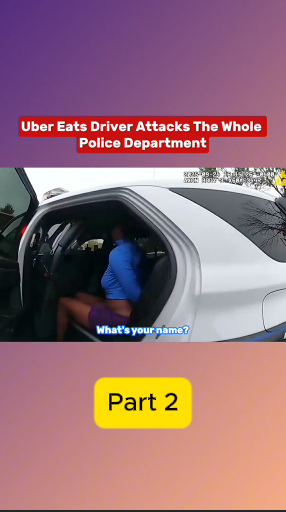
What began as an apparent dispute involving an Uber Eats delivery driver escalated into a chaotic confrontation with law enforcement, according to a police-video clip circulated online under the title “Uber Eats Driver Attacks The Whole Police Department.”
The dramatic title suggests a confrontation involving multiple officers, but it should not be taken literally as proof that an entire police department was attacked. The clip has attracted attention for its depiction of an increasingly tense encounter, with online viewers discussing the driver’s behavior, police response, and apparent use of a bicycle lock during the altercation.
Although the video has circulated publicly, important details—including the driver’s identity, the precise location, the formal criminal charges, and the ultimate court outcome—have not been independently verified for this article.
Nevertheless, the confrontation provides an opportunity to examine a serious legal issue: what happens when a disagreement involving a delivery worker escalates into alleged violence against police officers?
From criminal defense representation and assault charges to possible civil lawsuits and police use-of-force claims, the legal consequences can be significant.
A Delivery Dispute That Escalated Into a Police Confrontation
Food delivery drivers routinely face stressful situations involving delayed orders, customer complaints, missing items, and disagreements about payment or delivery instructions.
Most of these disputes are resolved through customer support or direct communication. Occasionally, however, a confrontation becomes serious enough for police intervention.
In the circulating Uber Eats video, the driver is portrayed as becoming increasingly confrontational during an encounter with law enforcement. Online discussions describe an argument involving food that the driver allegedly refused to surrender, followed by a heated exchange with responding officers.
The precise circumstances that brought police to the scene remain unclear from the publicly available information.
What makes the encounter particularly striking is the apparent progression from verbal disagreement to physical confrontation. Viewers discussing the footage have referenced the use of a bicycle lock, raising questions about whether an ordinary object could be considered a dangerous weapon under criminal law.
A police officer’s involvement changes the legal stakes. A person may disagree with an officer’s instructions, but threats or physical violence can expose that person to separate criminal allegations.
At the same time, police officers must follow constitutional requirements and applicable departmental policies when detaining or arresting someone.
The central legal question is not simply who appeared angrier in the video. It is what each person did, whether those actions were lawful, and what evidence supports the allegations.
When an Argument Becomes Assault on a Police Officer
In the United States, assault laws vary significantly by state.
Some jurisdictions define assault primarily in terms of threatening or attempting to cause physical injury. Others use assault to describe conduct involving actual unlawful physical contact. Separate battery offenses may also apply.
Many states impose enhanced penalties when the alleged victim is a law enforcement officer performing official duties.
Depending on the jurisdiction and circumstances, an alleged attack on an officer may result in charges involving assault, battery, aggravated assault, resisting arrest, or other offenses.
The severity of the charge may depend on several factors, including whether the officer was injured, whether a weapon was involved, and whether prosecutors can prove the required mental state.
A criminal defense attorney would examine the specific statutory elements rather than assuming that every physical struggle automatically constitutes aggravated assault.
For example, an accidental collision during a chaotic arrest may raise different legal questions from a deliberate strike intended to injure an officer.
Likewise, a person who is merely shouting at police is not necessarily committing an assault. The First Amendment protects substantial verbal criticism of government officials, although threats, obstruction, and other conduct may fall outside that protection.
The distinction between protected expression and criminal behavior is critical in confrontations captured by body cameras.
Could a Bicycle Lock Be Considered a Dangerous Weapon?
One of the more unusual aspects discussed by viewers of the Uber Eats confrontation is the apparent involvement of a bicycle lock.
Unlike a firearm or knife, a bicycle lock is an everyday object with an ordinary, lawful purpose.
However, an object’s normal purpose does not always determine how criminal law treats it.
Depending on the applicable statute and the way an item is used, an ordinary object may qualify as a dangerous or deadly weapon.
Courts may consider the object’s weight, construction, manner of use, force of impact, and potential to cause serious injury.
A heavy metal lock swung toward another person’s head could create substantially different legal risks from a lock simply being carried or held.
If prosecutors alleged that an object was used as a weapon, a defense lawyer would likely examine the available video, witness testimony, injury records, and physical evidence.
The prosecution would still need to prove the elements of any weapon-related charge.
The fact that online viewers describe an object as dangerous does not establish that a court would classify it that way.
That determination depends on the law and the evidence.
Resisting Arrest Versus Exercising Legal Rights
Another major issue in police confrontation cases is the distinction between refusing to cooperate verbally and physically resisting an arrest.
People in the United States have constitutional rights during interactions with law enforcement. Those rights may include protections against unreasonable searches and seizures and the right to remain silent in circumstances where statements could be self-incriminating.
However, exercising legal rights is not the same as physically fighting officers.
Resisting-arrest statutes differ by state, and the prosecution may need to prove that an officer was performing a lawful duty or that the defendant engaged in particular prohibited conduct.
In some jurisdictions, passive noncompliance and active physical resistance are treated differently.
A person who believes an arrest is unlawful should generally avoid physical confrontation and seek legal assistance afterward.
A criminal defense lawyer can challenge an arrest through motions, evidentiary hearings, or other court procedures when appropriate.
Whether the officer had a lawful basis to detain the driver would be an important issue if a resisting-arrest charge were filed.
The full body-camera recording, dispatch communications, witness statements, and events preceding the confrontation could all become relevant.
What Criminal Charges Could an Uber Eats Driver Face?
Without an authenticated charging document, it would be irresponsible to claim that the driver in the circulating video was convicted of any specific offense.
Nevertheless, similar confrontations may involve several categories of criminal allegations.
Assault or battery: Prosecutors may consider these offenses if evidence shows an unlawful threat or physical attack.
Aggravated assault: A more serious charge may apply where the required statutory factors are present, such as the use of a qualifying weapon or particular serious injuries.
Resisting or obstructing an officer: These allegations may arise when a person unlawfully interferes with an officer’s duties or physically resists an arrest.
Criminal mischief or property damage: If a confrontation results in damage to police equipment, vehicles, or other property, additional charges may be considered.
Disorderly conduct: Depending on the state, disruptive conduct meeting specific statutory requirements may support a separate charge.
These are general legal possibilities, not verified charges in the Uber Eats video.
An arrest does not establish guilt, and a defendant is presumed innocent unless proven guilty in court.
Why Hiring a Criminal Defense Lawyer Matters
An allegation involving violence against police can have serious consequences.
A defendant may face restrictive bail conditions, potential incarceration, financial penalties, probation, or other consequences depending on the charges and the applicable law.
That makes qualified legal representation particularly important.
A criminal defense attorney may review whether the initial police encounter was lawful, whether the arrest was supported by probable cause, and whether the evidence establishes each element of the alleged offense.
The lawyer may also examine whether an officer’s use of force affected the circumstances surrounding the alleged resistance.
Body-camera footage can be especially important.
A short video circulating on social media may show only the most dramatic moments. The complete recording may reveal instructions, warnings, attempts to de-escalate, physical contact, or other details that materially affect the case.
An attorney may seek relevant recordings, police reports, medical records, and witness statements through the legal process.
Defense counsel may also negotiate with prosecutors, pursue dismissal where justified, challenge evidence, or prepare for trial.
The appropriate strategy depends on the evidence and the defendant’s individual circumstances.
Could the Driver File a Lawsuit Against Police?
A person accused of attacking police officers may also claim that officers violated their rights.
The existence of criminal charges does not automatically eliminate the possibility of a civil claim.
However, a successful lawsuit requires evidence supporting a recognized legal cause of action.
For example, an excessive-force claim may arise if officers used force that was unreasonable under the applicable constitutional standard.
Courts evaluating such claims generally consider the circumstances confronting officers, including the severity of the suspected offense, whether a person posed an immediate threat, and whether the person was actively resisting or attempting to evade arrest.
The analysis is fact-specific.
An officer’s use of force is not automatically unlawful simply because the arrested person was injured. Conversely, an allegation of resistance does not authorize unlimited force.
Depending on the circumstances, a civil rights attorney may evaluate potential claims under federal law, including 42 U.S.C. § 1983, or applicable state law.
Legal barriers such as qualified immunity, procedural requirements, and filing deadlines may affect a case.
Anyone considering litigation should obtain advice from an attorney familiar with civil rights and police misconduct cases.
Could Injured Officers Pursue Compensation?
Civil liability can operate in the other direction as well.
If an officer is injured by another person’s unlawful conduct, potential remedies may depend on the circumstances and state law.
Workers’ compensation or employment-related benefits may address certain on-duty injuries.
In some circumstances, a separate civil claim against a responsible third party may also be possible, subject to applicable legal restrictions.
Compensation issues can involve medical expenses, lost income, disability, and other legally recoverable damages.
However, a criminal conviction does not automatically establish the amount of civil damages, and civil claims have their own evidentiary requirements.
A personal injury attorney can assess whether a particular claim is available and what evidence is needed.
What Happens to an Uber Eats Account After a Violent Arrest?
A confrontation involving an independent delivery worker can create consequences beyond criminal court.
Delivery platforms generally maintain policies addressing safety, violence, threats, and unacceptable conduct.
Depending on the platform’s policies and the verified circumstances, a driver may face an investigation, temporary account restriction, or permanent loss of access.
However, the mere existence of an arrest does not establish that a particular account was deactivated.
The driver’s contractual relationship with the platform may also raise separate questions about account access, payment disputes, and available appeal procedures.
An attorney experienced in contract or employment-related disputes may be able to explain the driver’s options, although independent-contractor arrangements can differ from traditional employment relationships.
It is also important to distinguish platform disciplinary action from criminal punishment. A private company may make account-access decisions under its contractual terms, while criminal liability must be determined through the legal system.
Why Full Bodycam Footage Matters More Than a Viral Headline
Police confrontation videos often spread rapidly because they contain shouting, physical struggles, or surprising behavior.
Headlines such as “Uber Eats Driver Attacks The Whole Police Department” are designed to attract attention, but they do not necessarily describe the precise legal facts.
An edited video may omit the beginning of an encounter, the reason officers responded, or events that occurred after an arrest.
Viewers may also misunderstand an officer’s instructions or the actions of someone experiencing distress.
For journalists, lawyers, and the public, the responsible approach is to separate observable conduct from unverified allegations.
A complete investigation should examine relevant recordings, witness accounts, physical evidence, and official records.
If criminal proceedings occur, the resulting court documents may provide a more reliable account of the charges and outcome than a social-media caption.
This distinction matters because inaccurate claims can damage reputations and mislead readers about the justice system.
Final Thoughts: A Confrontation With Serious Legal Implications
The circulating Uber Eats police confrontation highlights how quickly a dispute can escalate when communication breaks down and physical force enters the situation.
An argument over a delivery may begin as a customer-service issue. But if violence occurs, the consequences can extend to criminal charges, potential civil liability, medical expenses, legal representation, and loss of professional opportunities.
For police, the central obligations include enforcing the law while respecting constitutional protections and using force only when legally justified.
For accused individuals, the legal system provides rights, procedural safeguards, and opportunities to challenge the evidence.
And for anyone watching a viral arrest video, the most important lesson may be that dramatic footage is only part of the story.
Whether the driver committed a crime, whether officers acted lawfully, and whether anyone has a viable lawsuit are questions that require evidence—not just an attention-grabbing headline.
Legal Disclaimer
This article is for informational and educational purposes only and does not constitute legal advice. The discussion is based on a publicly circulated video title and limited online descriptions; the specific allegations, charges, identities, and final court outcome have not been independently verified. General legal scenarios discussed here should not be interpreted as facts established about the individuals shown in the video. Criminal laws, civil liability standards, and legal procedures vary by jurisdiction. Anyone facing criminal charges or considering legal action should consult a licensed attorney.
Để lại một phản hồi