👇 SCROLL DOWN TO WATCH THE VIDEO! 🎥🚨
Police Arrest Angry Woman at Walmart After She Claims Items Should Be Free — Could a Shoplifting Case Lead to a Lawsuit?
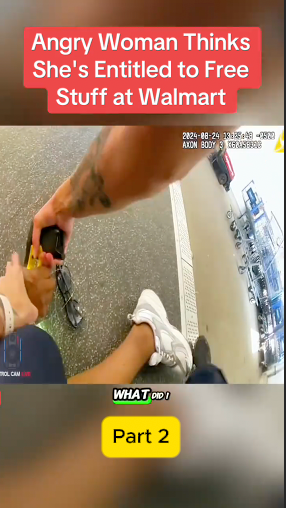
A confrontation at a Walmart store has reignited debate about shoplifting, customer behavior, police authority, and the legal consequences of refusing to pay for merchandise. In a widely circulated police-video recap, a woman accused of taking items without paying reportedly argued that certain merchandise was supposed to be free. The encounter escalated into a police investigation and arrest, raising questions about what happens when a retail dispute becomes a criminal case.
The incident, described in an online video recap, reportedly occurred on January 4, 2024. According to the available account, Walmart loss-prevention personnel told responding officers that a woman had left the store with merchandise that had not been paid for. Officers located her near a Subway restaurant, where they investigated the allegation and examined information provided by store security.
The video account describes a woman who disputed the accusation and appeared unwilling to accept the store’s explanation. Her reported claim that certain items should have been free became a memorable part of the encounter. However, the available online summary does not establish every detail of the underlying case or its final court outcome. The incident should therefore be understood through the reported allegations rather than assumptions about facts that have not been independently confirmed.
Beyond the viral moment, the case raises important legal questions: When does a disagreement over merchandise become theft? What rights does a person have during a police investigation? Can a retailer face a lawsuit after an allegedly wrongful detention? And when should someone contact a criminal defense lawyer?
How a Walmart Shopping Dispute Turned Into a Police Investigation
Retail stores such as Walmart use loss-prevention employees, surveillance cameras, transaction records, and other security procedures to investigate suspected theft. When staff believe merchandise has been taken without payment, they may report the incident to law enforcement.
In the reported Walmart encounter, officers responded after store personnel described a suspected shoplifting incident. The online recap says the woman had left the store and was subsequently located nearby. Store security reportedly provided information about the merchandise, while officers investigated the circumstances surrounding the allegation.
The woman’s response became a central feature of the circulating footage. Rather than simply accepting the accusation, she reportedly maintained that she had not done anything wrong and questioned the basis for the detention. The claim that certain items were supposed to be free added another layer to the disagreement.
But a person’s explanation does not automatically establish guilt or innocence. Investigators generally need to consider the available evidence, including what was purchased, what appeared on the receipt, whether merchandise passed the final point of sale, and what surveillance footage actually shows.
A disagreement about a product’s price or a store promotion can sometimes be a genuine misunderstanding. A person may believe an item is free, misunderstand a promotion, or encounter an error at self-checkout. Conversely, deliberately leaving with merchandise while knowing it has not been paid for may support a theft allegation under applicable law.
The distinction depends on the evidence and the relevant state’s criminal statutes.
Can Believing an Item Is Free Be a Legal Defense?
One of the most important questions in a suspected shoplifting case is whether the person intended to steal.
In many U.S. jurisdictions, theft offenses require proof of a particular mental state, such as knowingly taking or exercising unauthorized control over another person’s property with the intent to deprive the owner of it. The exact wording and elements vary by state, and prosecutors must establish the elements required by the applicable statute.
If a customer genuinely believed an item was free because of a clearly displayed promotion, a confusing price label, or a checkout error, that belief could be relevant to the case. It would not automatically excuse every failure to pay, but it might help explain what the customer understood at the time.
Evidence could include:
- Store advertisements and promotional signs.
- Shelf labels and price tags.
- Receipts and self-checkout transaction records.
- Surveillance footage showing the customer’s actions.
- Statements made to employees or officers.
- Witness accounts concerning what the customer was told.
- Store policies or records showing how a promotion was applied.
A criminal defense attorney can review this evidence and determine whether it supports a defense, creates reasonable doubt, or suggests that the incident resulted from a misunderstanding rather than intentional theft.
On the other hand, simply insisting that merchandise should have been free does not settle the question. If the evidence shows that a person knowingly concealed merchandise or deliberately bypassed payment, a prosecutor may argue that the conduct satisfies the elements of a theft offense.
Ultimately, the legal outcome depends on admissible evidence, the applicable law, and the decisions made by prosecutors and the court.
What Charges Could Follow a Suspected Shoplifting Incident?
The exact charge in a retail theft case depends on the jurisdiction, the value and type of merchandise, the alleged conduct, and any relevant prior convictions.
Depending on the circumstances and local law, a suspected shoplifting incident may lead to a misdemeanor theft charge, a higher-level offense, or another retail-theft-related charge. Some states also have specific statutes governing organized retail theft, merchandise concealment, or other conduct associated with retail losses.
Potential consequences can include court appearances, fines, probation, restitution, diversion programs, or incarceration. These are possible outcomes in retail theft cases generally, not a statement that any particular sentence was imposed in the Walmart incident described here.
A person who is arrested is not automatically guilty. An arrest reflects law enforcement’s decision to take someone into custody based on the circumstances known at that time; it is not the same as a conviction.
The prosecution must establish the required elements of the charge under the applicable legal standard. Depending on the case, the defense may challenge the identification of the suspect, the interpretation of video footage, the alleged value of the merchandise, or whether the evidence establishes the required intent.
Anyone facing a retail theft charge should consider consulting a qualified criminal defense lawyer in the state where the incident occurred. Early legal advice can help a defendant understand court deadlines, potential penalties, available defenses, and the risks of making statements about the case.
Why Surveillance Footage and Receipts Matter
In retail theft investigations, surveillance footage and transaction records can become some of the most important pieces of evidence.
Video may show whether merchandise was placed in a bag, whether items were scanned at checkout, and whether a customer passed the final point of sale. However, footage must be interpreted in context. A camera angle may not capture every item, and a short clip may omit events that occurred before or after the recorded interaction.
Receipts and register records can help establish which items were purchased. Price labels, promotional terms, and store communications may also matter if the customer claims that merchandise was supposed to be free.
A defense attorney may request or review available evidence through the appropriate legal procedures. If a video appears to contradict the accusation, that discrepancy may be significant. Likewise, if the footage supports the store’s account, it may strengthen the prosecution’s position.
Customers who believe they have been falsely accused should preserve relevant receipts, order confirmations, promotional screenshots, and other records. They should avoid altering evidence or posting misleading excerpts online.
The full record—not merely the most dramatic moment in a viral clip—may determine how a case is resolved.
Can Walmart or Store Security Be Sued After an Arrest?
The possibility of a lawsuit is another issue that often arises when a retail confrontation circulates online. A person who believes they were wrongly accused, detained, or treated unlawfully may wonder whether Walmart, a security employee, or a responding police department can be held responsible.
The answer depends on the specific facts and the law governing the incident.
In some states, retailers have statutory protections or privileges that allow them to detain a suspected shoplifter for a reasonable period when they have an appropriate basis for suspecting theft and follow the applicable legal requirements. These rules are sometimes described as shopkeeper’s privilege. The details and limitations differ by jurisdiction.
That protection is not necessarily unlimited. A detention that lacks a sufficient factual basis, lasts unreasonably long, or involves unlawful conduct may raise potential civil claims, depending on the circumstances.
Possible legal theories in an appropriate case may include false imprisonment, false arrest, negligence, or other claims recognized by state law. A person might also raise concerns about defamation if false statements were communicated to third parties and the legal requirements for that claim were satisfied.
However, being accused of shoplifting does not automatically create a valid lawsuit. Nor does an arrest alone prove that a retailer or police officer acted unlawfully.
A civil attorney would need to evaluate the available evidence, the reason for the detention, what store personnel knew at the time, how law enforcement became involved, and whether any legally protected conduct applies.
If a customer believes a detention was improper, a lawyer can explain whether a civil claim is viable, what evidence should be preserved, and what filing deadlines may apply.
Could Police Face Legal Liability?
Police officers responding to suspected shoplifting calls must assess the information available to them and act within the law.
An officer may consider statements from store employees, surveillance footage, witness accounts, and other evidence when deciding whether there is a legal basis to detain or arrest a person. The fact that a store employee reports suspected theft does not eliminate the need for lawful police conduct.
At the same time, an arrest that does not result in a conviction is not automatically unlawful. The legal question often turns on the information available to officers, the applicable standards for detention or arrest, and the specific actions taken.
Claims involving police misconduct can be legally complex. Depending on the circumstances, potential issues might include an arrest without probable cause, unreasonable force, or other violations of constitutional or state law. Governmental immunity and other legal defenses may also affect whether a lawsuit can proceed.
Anyone considering a claim against a law enforcement agency should consult a civil rights attorney or another lawyer experienced in the relevant area of law. These cases require careful analysis of the facts and applicable legal standards.
What Should a Customer Do When Accused of Shoplifting?
A retail theft accusation can become stressful very quickly, particularly when security personnel or police officers become involved. The way a person responds may affect both the immediate encounter and any later legal proceedings.
Several practical steps may help protect a person’s interests.
Remain calm and avoid escalating the confrontation. Shouting, threatening employees, or physically resisting a lawful detention can create additional risks and may lead to separate allegations.
Keep relevant records. Receipts, bank transactions, digital orders, promotional materials, and other records may help explain what happened.
Do not assume a viral video tells the whole story. A short clip may omit important events, including what happened before officers arrived or what evidence was available to them.
Understand your rights. If questioned by police about a suspected crime, a person may have rights under the U.S. Constitution and state law. The precise rules depend on the circumstances. Anyone uncertain about how to respond should seek qualified legal advice.
Contact a lawyer when appropriate. A criminal defense attorney can explain the allegations, evaluate potential defenses, and help the accused navigate the court process. A separate civil attorney may be appropriate if there is credible evidence of unlawful detention or other misconduct.
These steps are general information, not a substitute for advice tailored to a particular case.
The Bigger Issue: Retail Security, Accountability, and Fair Treatment
Retail theft creates real costs for businesses and can affect employees, customers, and store operations. Retailers therefore have legitimate reasons to investigate suspected losses and take reasonable steps to protect merchandise.
But fair treatment also matters. A customer who has made an honest mistake should not automatically be treated as a criminal, and a person accused of theft should not be presumed guilty simply because a video has attracted attention online.
The challenge is balancing loss prevention with accurate investigations, lawful detentions, and respect for individual rights.
For retailers, that means maintaining clear procedures, training staff to document suspected theft accurately, and ensuring that allegations are based on evidence rather than assumptions. For law enforcement, it means independently assessing the information available and following applicable legal standards. For customers, it means understanding that merchandise generally must be paid for unless a valid promotion or other arrangement says otherwise.
The Walmart incident described in the online recap has drawn attention because of the reported disagreement over whether merchandise should have been free. Yet the broader lesson extends beyond one confrontation: a heated exchange in a store can have consequences that reach far beyond the checkout counter.
Legal Disclaimer
This article is intended for general informational and educational purposes only. It discusses a reported retail-theft encounter based on an online video recap; the full underlying case record and final legal outcome have not been independently established here. Allegations should not be treated as proof of guilt. Laws governing shoplifting, detention, arrest, and civil liability vary by state. Nothing in this article constitutes legal advice or creates an attorney-client relationship. Anyone facing criminal charges or considering a lawsuit should consult a licensed attorney in the relevant jurisdiction.
Để lại một phản hồi